
About Ayodhya
Ayodhya is named after King Ayudh, who is mentioned in the ancient Hindu scriptures as forefathers of Lord Rama. It is the birth place of Lord Rama, the seventh incarnation of Lord Vishnu is popular among pilgrims and tourists. This religious town lies on the bank of river Saryu, and is mentioned as one of the seven most sacred places in Skanda Purana. The city holds an important position in the ancient Hindu epic, Ramayana, which describes the story of Lord Rama’s birth, his 14 years of exile, and his victory over evil Ravana. The most celebrated festival of India, Diwali is celebrated for the return of Lord Rama to Ayodhya after defeating Ravana. Ayodhya is a city of temples and is an important pilgrim place for Hindus in India. The city of temples has plenty of religious sites including Hanuman Garhi – an ancient temple that houses child statue of Lord Hanuman seated in lap of mother Anjani, Treta ka Mandir – the place where Lord Ram believed to have performed Ashvamedha Yagnya and Nageshwarnath temple – believed to be established by Kush, son of Lord Ram, Ramkot temple – the main place of worship for Hindu devotees, and holy ghats. The city is also home to many historical and pilgrimage sites that belong to the Jain and Buddhist religion.
History of Ayodhya
Ayodhya is a holy city of ancient India. It is one of the seven most sacred cities of the Hindus in India and situated about 135 km from Lucknow, on the banks of the Saryu river. It was the capital of Hindu kingdom of Kosala. The city is known for being the court of King Dasharatha, who was the father of Lord Rama, an incarnation of Lord Vishnu. Valmiki Ramayana the famous devotional poems are believed to be written by Valmiki here itself. Ayodhya is an equally important place for Jains and Sikhs. Ayodhya is a city of temples as there are about 300 temples. It also holds important position among Jain religion as it is the birth place of two important Jain Tirthankaras. The city later came under the rule of Gupta Empire and also got influenced with Buddhism. Several Buddhist temples are also built here. Ayodhya later came under the rule of Mughal Empire, slowly losing strategic importance to Lucknow and Kanpur.
Places to visit in Ayodhya
Ramkot
It is main place of worship in the town which is visited by thousands of devotees and tourists throughout the year. It stands on an elevated ground in the western part of the city. Ram Navami, the day of Lord Ram’s birth, is celebrated with great pomp and fervour in the Chaitra month of the Hindu calendar that falls between March and April.
Mani Hill and Sugriv Hill
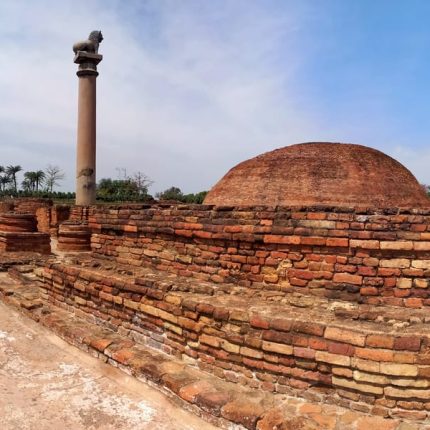
Mani Hill has an ancient stupa that is believed to have been built by Emperor Ashoka while Sugriv parvat is believed to be an ancient monastery
Nageshvarnath Temple
The temple of Nageshwarnath is said to have been established by Kush the son of Rama. It is said that this has been the only temple to have survived till the time of Vikramaditya, the rest of city had fallen into ruins and was covered by dense forests. According to a legend, Kush lost his arm band in the Saryu River which was found by Naag Kanya who fell in love with him. In honor of Naag Kanya and her devotion to Shiva, Kush built the temple for her. It is said that all other structures except for this temple were ruined and it was because of the temple that Vikramaditya found Ayodhya. The festival of Shivratri is celebrated with great pomp and show in the temple. .
Ramkatha Museum
The Ramkatha museum was established in Ayodhya since 1988. This museum is engaged in collection, preservation and conservation of antiquities related to the story of Lord Rama
Tulsi Smarak Bhawan
It was built in the memory of Goswami Tulsidas and is used for prayers, meetings and religious discourses. It also houses the ‘Ayodhya Shodh Sansthan’, where a large collection of literary
works on Swami Tulsidas can be seen
Treta Temple
It is an ancient temple that was built by Raja of Kullu about 300 years ago, and renovated by Ahalyabai Holkar of Indore in 1784, at the same time the adjoining Ghats were also built. It is believed that at this place Lord Ram had performed the Ashvamedha Yajnya. Also known as Kaleram Temple, the ancient idols made from black sandstone were lost in the Saryu River but were later recovered and placed in the temple
Kanak Bhavan
It is also known as Sone ka Ghar meaning house made of gold. Kanak Bhawan was built in 1891 by the Queen of Tikamgarh, Vrishbhanu Kuvari. It is one of the finest temples in Ayodhya. The temple has images of Lord Ram and Sita wearing gold crowns enshrined inside the Garbhagriha.
Hanuman Garhi
Hanumangarhi is one of the most important temples of Ayodhya. It is located in the centre of Ayodhya, is the most popular shrine in Ayodhya and is approachable by a flight of 76 steps. It is believed that Hanuman lived here in a cave and guarded the Janambhoomi or Ramkot. The temple has a shrine of Goddess Anjani with Hanuman in her lap. According to faithful believe that all their wishes are granted with a visit to this holy shrine.
Vijayraghaw temple
The temple is built in 2008 and it is one of the best temples in Ayodhya. In this temple god Ram is presented in 12 faces called Viswa-virat meaning world’s big. This temple is made up of red marbles and stainless steel. .
MOST POPULAR TOURS